


A Guide To Google Search Ranking Systems. How Google Ranks Websites

Updated: Aug 12

Have you ever wondered why one website appears at the top of Google Search while another, offering similar products or services, is buried on page five?
It's a question millions of business owners, marketers, bloggers, and website managers ask every day. Some assume the answer is simply using the right keywords. Others believe Google favors large companies with bigger budgets. In reality, neither is entirely true.
Google's Search ranking systems are designed with one goal in mind: to provide users with the most helpful, relevant, and trustworthy information for every search they perform.
Every time someone types a question into Google, sophisticated Google Search ranking systems analyze billions of web pages in seconds to determine which ones deserve to appear first.
Understanding how Google ranks websites isn't about trying to outsmart the algorithm, it's about creating a website that genuinely deserves to rank. When you understand what Google looks for, you can improve your website in ways that benefit both search engines and your visitors.
In this guide, we'll break down how Google Search works, explain the most important Google ranking factors, and share practical SEO strategies that can help your website earn better visibility and attract more organic traffic.
Before Your Website Can Rank, Google Must Find It
Many people focus entirely on rankings without realizing that a website must first go through three important stages before it can appear in Google Search.
The first stage is crawling. Google uses automated programs known as Googlebots to discover new and updated pages across the internet.
These bots follow links from one webpage to another, continuously exploring websites to find fresh content.
The second stage is indexing. Once Google discovers your pages, it analyzes their content and stores relevant information in its massive search index.
Think of this index as a giant digital library containing billions of webpages. If your page isn't indexed, it cannot appear in search results.
The final stage is ranking. When someone performs a search, Google's ranking systems evaluate indexed pages and determine which ones best match the user's query.
The pages that provide the most relevant, helpful, and trustworthy information are more likely to appear near the top of the results.
Understanding these three stages helps explain why simply publishing a website isn't enough. Your content must be discoverable, understandable, and valuable before Google can rank it.
Google Doesn't Use One Algorithm, It Uses Many Ranking Systems
One of the biggest misconceptions in SEO is that Google relies on a single algorithm.
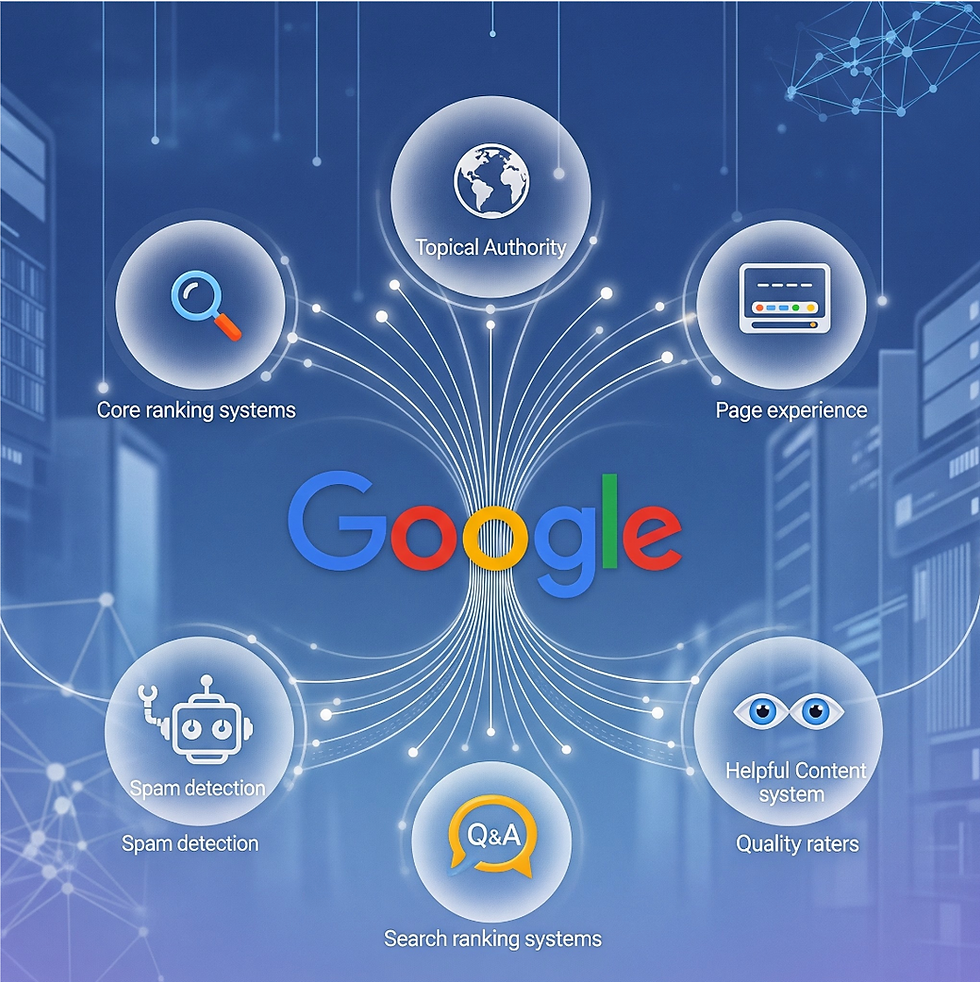
In reality, Google uses multiple Search ranking systems, each designed to evaluate different aspects of a webpage.
These systems work together to understand the meaning of a search query, evaluate the quality of available content, identify trustworthy sources, detect spam, and determine which pages are most helpful for users.
Rather than relying on one signal, Google considers hundreds of ranking factors when deciding where a webpage should appear.
These systems are continually updated to improve search quality and ensure users receive accurate, useful, and relevant information.
This is why effective search engine optimization (SEO) focuses on creating high-quality websites rather than exploiting shortcuts or temporary ranking tricks.
Relevance Is The First Thing Google Looks For
Imagine searching for "best hiking boots" and receiving results about office shoes. Even if those webpages were beautifully designed, they wouldn't answer your question.
Google's priority is relevance. Its ranking systems analyze search queries and compare them with webpage content to determine whether a page genuinely answers the user's query.
This process involves much more than matching keywords. Google evaluates topics, context, synonyms, search intent, and the overall usefulness of the information.
For this reason, modern SEO is less about repeating keywords and more about creating comprehensive content that thoroughly answers users' questions.
When your content aligns with search intent, Google is much more likely to consider it relevant.
Helpful Content Wins Over Keyword Stuffing
Years ago, some websites ranked simply by repeating keywords dozens of times. Today, those tactics are ineffective and can even hurt rankings.
Google's ranking systems prioritize helpful content that demonstrates genuine expertise and provides value to readers.
A high-quality article should answer common questions, explain complex topics clearly, solve problems, and offer practical guidance. Readers should leave your page feeling that they found exactly what they were looking for.
Instead of writing for search engines alone, successful websites write for people first. Ironically, that's exactly what Google wants.
The more useful your content is, the greater your chances of earning stronger organic search rankings.
User Experience Plays A Bigger Role Than Ever
Creating excellent content is only part of the equation. Google also wants visitors to enjoy using your website.
If your pages load slowly, are difficult to navigate, or don't work properly on mobile devices, users are likely to leave quickly. Poor user experiences send signals that your website may not be providing the best solution.
A positive page experience includes fast loading speeds, mobile-friendly design, intuitive navigation, secure browsing with HTTPS, readable content, and minimal interruptions from intrusive pop-ups.
Improving the overall user experience benefits both your visitors and your Google ranking. When users find your website easy to use, they're more likely to stay longer, explore additional pages, and return in the future.

Authority And Trust Matter More Than Popularity
Not every website discussing a topic carries the same level of credibility.
Google attempts to identify pages that demonstrate expertise, authority, and trustworthiness.
This concept is commonly known as E-E-A-T, which stands for Experience, Expertise, Authoritativeness, and Trustworthiness.
For example, if someone searches for financial advice or medical information, Google wants to display content created by knowledgeable, credible sources rather than random opinions.
Businesses can strengthen trust by publishing accurate information, citing reputable sources when appropriate, showcasing industry expertise, maintaining transparent contact information, and consistently producing valuable content.
Building authority takes time, but it is one of the strongest long-term investments any website can make.
Backlinks Continue To Strengthen Website Authority
A backlink is simply a link from another website pointing to yours. Google views high-quality backlinks as signals that other websites consider your content valuable enough to recommend.
However, not all backlinks carry the same value.
A single backlink from a respected industry publication can be more beneficial than dozens of links from low-quality websites.
The best way to earn backlinks is by creating exceptional content that people naturally want to reference, share, and recommend.
Trying to purchase or manipulate backlinks often leads to poor results and can even violate Google's guidelines. Quality always outweighs quantity.
Technical SEO Helps Google Understand Your Website
Even excellent content can struggle to rank if search engines encounter technical problems while crawling your website. Technical SEO focuses on making your website easier for Google to access, understand, and index.
Important technical factors include clean website architecture, properly optimized URLs, XML sitemaps, structured data, internal linking, mobile responsiveness, secure HTTPS connections, and fast page loading speeds.
Technical optimization doesn't replace quality content, it supports it by ensuring Google can fully evaluate your website. Think of technical SEO as building strong foundations beneath an impressive building.

Common SEO Mistakes That Hurt Google Rankings
Many websites unintentionally reduce their own visibility by making avoidable SEO mistakes. Here are some of the most common ones:
Publishing thin contentThin content gives readers very little value and gives Google little reason to rank the page highly. If a page only scratches the surface of a topic, it often fails to demonstrate real expertise or usefulness.
Creating duplicate contentWhen the same or very similar content appears on multiple pages, Google may struggle to determine which version should rank. This can dilute visibility and weaken the overall authority of your website.
Keyword stuffingRepeating keywords too often makes content sound unnatural and difficult to read. It also signals poor optimization practices, which can hurt both user experience and search performance.
Ignoring broken linksBroken links create a frustrating experience for visitors and can make a website feel neglected. They also interrupt the flow of crawling and may reduce the overall quality of your site in Google’s eyes.
Leaving outdated information on the siteOld statistics, expired offers, and outdated advice can make your content less trustworthy. Google favors fresh, accurate information, especially when users are searching for current answers.
Having poor mobile usabilityIf a website is difficult to use on a phone or tablet, visitors are more likely to leave quickly. Since mobile experience is a major ranking factor, poor usability can directly affect visibility.
Allowing slow-loading pagesSlow websites frustrate users and increase bounce rates. Page speed is an important part of technical SEO, and sluggish performance can make it harder for pages to rank well.
Writing without search intent in mindEven well-written content can fail if it does not match what the user actually wants to find. If your page does not answer the right question or solve the right problem, it is unlikely to perform well in Google Search.
Regular website audits help identify these issues before they become major obstacles to growth.
SEO Is A Long-Term Investment, Not A Quick Fix
Many businesses expect SEO results within a few weeks. In reality, search engine optimization is a long-term strategy built on consistency.
Google continually evaluates websites as new content is published, user behavior changes, competitors improve their websites, and ranking systems evolve.
Businesses that consistently publish helpful content, improve website performance, earn quality backlinks, and provide excellent user experiences often experience steady improvements over time.
Unlike paid advertising, strong organic rankings can continue generating qualified traffic long after the initial optimization work is complete.
Patience and consistency remain two of the most valuable SEO strategies.
The Future Of Google Search Is Becoming More User-Focused
Google's ranking systems continue to evolve alongside advances in artificial intelligence and user behavior.
Features such as AI-powered search experiences, AI Overviews, semantic search, and improved understanding of user intent mean that content quality has never been more important.
Rather than rewarding websites that simply target keywords, Google increasingly rewards businesses that provide complete, trustworthy, and people-first answers.
The future of SEO belongs to websites that educate, solve problems, and genuinely help users make informed decisions.

In a Nutshell
Understanding how Google ranks websites isn't about discovering secret ranking formulas; it's about understanding what Google ultimately wants to achieve.
Every update to the Google Search ranking systems is designed to help users find the most relevant, trustworthy, and helpful content as quickly as possible.
By focusing on high-quality content, technical SEO, search intent, user experience, website authority, and continuous improvement, your business can build a stronger online presence that performs well in both today's search environment and tomorrow's.
At Linx Solutions, we help businesses navigate the ever-changing world of search engine optimization with ethical, data-driven strategies that deliver sustainable growth.
From comprehensive SEO audits and technical optimization to keyword research, content creation, local SEO, and ongoing performance monitoring, our team works to improve your Google rankings while creating exceptional experiences for your visitors.
If you're ready to increase your search visibility, attract more qualified traffic, and turn your website into a powerful business asset, Linx Solutions is here to help you climb the rankings, one smart SEO strategy at a time.


Comments